

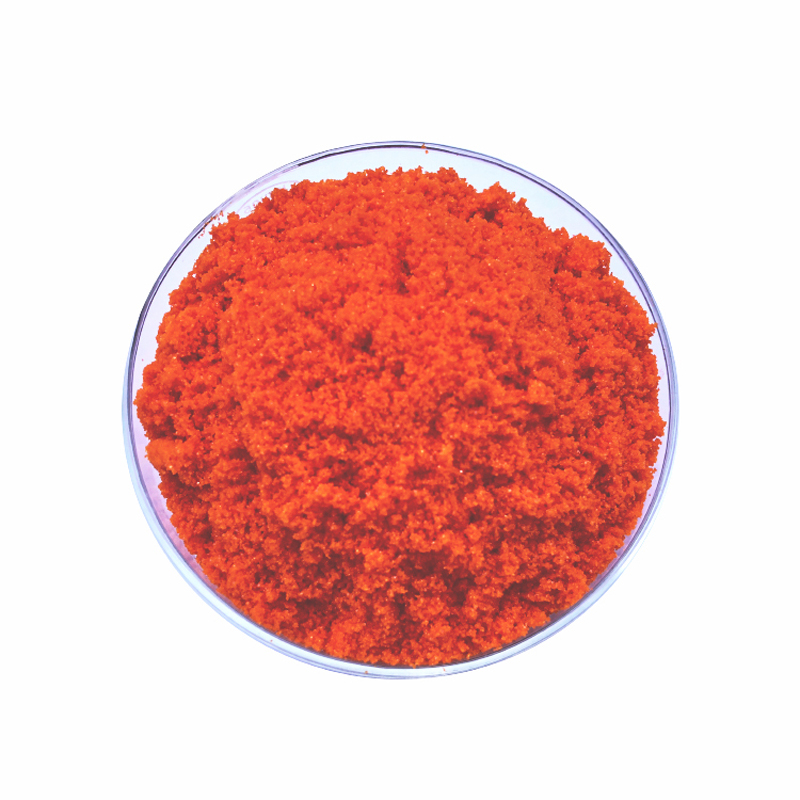
Nitrati ya Ammoniamu ya Seriamu (Ce(NH4)2(HAPANA3)6(Nambari ya CAS 16774-21-3)
Maelezo ya bidhaa
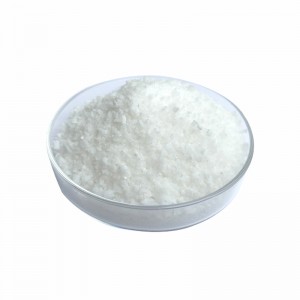
Nitrati ya seriamu ya amonia ni mchanganyiko wa rangi ya chungwa-nyekundu unaoyeyuka sana katika maji na oksidi kali. Hutumika sana kama kichocheo na kioksidishaji kwa usanisi wa kikaboni, mwanzilishi wa mmenyuko wa upolimishaji, na wakala babuzi kwa saketi jumuishi. Kama kioksidishaji na mwanzilishi, nitrati ya seriamu ya amonia ina faida za mmenyuko mkubwa, uteuzi mzuri, kipimo kidogo, sumu kidogo na uchafuzi mdogo.
Kampuni ya WONAIXI (WNX) imeweka Cerium Ammonium Nitrate katika uzalishaji mkubwa tangu 2011 na kuendelea kuboresha mchakato wa uzalishaji ili kuwapa wateja bidhaa zenye ubora wa juu, na njia ya hali ya juu ya mchakato wa kuomba hati miliki ya uvumbuzi wa kitaifa wa mchakato wa uzalishaji wa Cerium Ammonium Nitrate. Tumeripoti mafanikio ya utafiti na maendeleo ya bidhaa hii kwa idara ya sayansi na teknolojia ya kitaifa, na mafanikio ya utafiti wa bidhaa hii yametathminiwa kama kiwango kinachoongoza nchini China. Kwa sasa, WNX ina uwezo wa uzalishaji wa kila mwaka wa tani 3000 za Cerium Ammonium Nitrate.
Vipimo vya bidhaa
| Nitrati ya Ammoniamu ya Seriamu | |||||
| Fomula: | Ce(NH)4)2(HAPANA3)6 | CAS: | 16774-21-3 | ||
| Uzito wa Fomula: | Nambari ya EC: | 240-827-6 | |||
| Visawe: | Ammoniamu seriamu (IV) nitrati; Seriamu (IV) Ammoniamu nitrati; Ammoniamu nitrati ya seriamu; | ||||
| Sifa za Kimwili: | Fuwele nyekundu-chungwa, mumunyifu sana katika maji | ||||
| Vipimo 1 | |||||
| Nambari ya Bidhaa | CAN-4N | ARCAN-4N | |||
| TREO% | ≥30.5 | ≥30.8 | |||
| Usafi wa seriamu na uchafu wa udongo adimu unaohusiana | |||||
| CeO2/TREO% | ≥99.99 | ≥99.99 | |||
| La2O3/TREO% | <0.004 | <0.004 | |||
| Pr6eO11/TREO% | <0.002 | <0.002 | |||
| Nd2O3/TREO% | <0.002 | <0.002 | |||
| Sm2O3/TREO% | <0.001 | <0.001 | |||
| Y2O3/TREO% | <0.001 | <0.001 | |||
| Uchafu usio na udongo adimu | |||||
| Ca% | <0.0005 | <0.0001 | |||
| Fe % | <0.0003 | <0.0001 | |||
| Asilimia ya Na | <0.0005 | <0.0001 | |||
| K % | <0.0003 | <0.0001 | |||
| Asilimia ya Zn | <0.0003 | <0.0001 | |||
| Al % | <0.001 | <0.0001 | |||
| Ti % | <0.0003 | <0.0001 | |||
| SiO2 % | <0.002 | <0.001 | |||
| Cl- % | <0.001 | <0.0005 | |||
| S/REO % | <0.006 | <0.005 | |||
| Ce4+/Si% | ≥97 | ≥97 | |||
| [H+]/[M+] | 0.9-1.1 | 0.9-1.1 | |||
| NTU | <5.0 | <3.0 | |||
| Vipimo 2 | |
| Nambari ya Bidhaa | EGCAN-4N |
| TREO% | ≥31 |
| Usafi wa seriamu na uchafu wa udongo adimu unaohusiana | |
| CeO2/TREO% | ≥99.99 |
| La2O3/TREO% | <0.004 |
| Pr6eO11/TREO% | <0.002 |
| Nd2O3/TREO% | <0.002 |
| Sm2O3/TREO% | <0.001 |
| Y2O3/TREO% | <0.001 |
| Uchafu usio na udongo adimu | |
| Ca% | <0.00005 |
| Fe % | <0.00005 |
| Asilimia ya Na | <0.00005 |
| K % | <0.00005 |
| Asilimia ya Pb | <0.00005 |
| Asilimia ya Zn | <0.00005 |
| Mn % | <0.00005 |
| Mamiligramu % | <0.00005 |
| Asilimia ya Ni | <0.00005 |
| Cr % | <0.00005 |
| Al % | <0.00005 |
| Ti % | <0.00005 |
| Asilimia ya CD | <0.00005 |
| Cu % | <0.00005 |
| NTU | <0.8 |
Utambuzi wa Hatari ya SDS
1. Classification of the substance or mixture
Oxidizing solids, Category 2
Corrosive to metals, Category 1
Acute toxicity – Oral, Category 4
Skin corrosion, Category 1C
Skin sensitization, Category 1
Serious eye damage, Category 1
Hazardous to the aquatic environment, short-term (Acute) – Category Acute 1
Hazardous to the aquatic environment, long-term (Chronic) – Category Chronic 1
2. GHS label elements, including precautionary statements
| Pictogram(s) | |
| Signal word | Danger |
| Hazard statement(s) | H272 May intensify fire; oxidizerH290 May be corrosive to metalsH302 Harmful if swallowedH314 Causes severe skin burns and eye damageH317 May cause an allergic skin reactionH400 Very toxic to aquatic lifeH410 Very toxic to aquatic life with long lasting effects |
| Precautionary statement(s) | 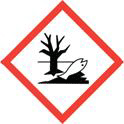  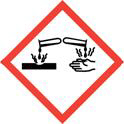 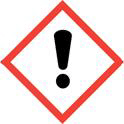 |
| Prevention | P210 Keep away from heat, hot surfaces, sparks, open flames and other ignition sources. No smoking.P220 Keep away from clothing and other combustible materials.P280 Wear protective gloves/protective clothing/eye protection/face protection.P234 Keep only in original packaging.P264 Wash … thoroughly after handling.P270 Do not eat, drink or smoke when using this product.P260 Do not breathe dust/fume/gas/mist/vapours/spray. P261 Avoid breathing dust/fume/gas/mist/vapours/spray. P272 Contaminated work clothing should not be allowed out of the workplace. P273 Avoid release to the environment. |
| Response | P370+P378 In case of fire: Use … to extinguish.P390 Absorb spillage to prevent material damage.P301+P312 IF SWALLOWED: Call a POISON CENTER/doctor/\u2026if you feel unwell.P330 Rinse mouth.P301+P330+P331 IF SWALLOWED: Rinse mouth. Do NOT induce vomiting.P303+P361+P353 IF ON SKIN (or hair): Take off immediately all contaminated clothing. Rinse skin with water [or shower].P363 Wash contaminated clothing before reuse. P304+P340 IF INHALED: Remove person to fresh air and keep comfortable for breathing. P310 Immediately call a POISON CENTER/doctor/\u2026 P321 Specific treatment (see … on this label). P305+P351+P338 IF IN EYES: Rinse cautiously with water for several minutes. Remove contact lenses, if present and easy to do. Continue rinsing. P302+P352 IF ON SKIN: Wash with plenty of water/… P333+P313 If skin irritation or rash occurs: Get medical advice/attention. P362+P364 Take off contaminated clothing and wash it before reuse. P391 Collect spillage. |
| Storage | P406 Store in a corrosion resistant/…container with a resistant inner liner.P405 Store locked up. |
| Disposal | P501 Dispose of contents/container to … |
3. Other hazards which do not result in classification
None
SDS Transport Information
| UN number: | ADR/RID: UN3085 IMDG: UN3085 IATA: UN3085 | |||
| UN proper shipping name: |
Model Regulations. | |||
| Transportation primary hazard class: |
| |||
| Transportation secondary hazard class: | - | |||
| Packing group: |
| |||
| Hazard labeling: | - | |||
| Marine Pollutants (Yes/No): | No | |||
| Special precautions relating to transport or means of transport: | Transport vehicles shall be equipped with fire fighting equipment and leakage emergency treatment equipment of the corresponding variety and quantity.It is strictly prohibited to mix with oxidants and edible chemicals.The exhaust pipes of vehicles carrying the articles must be equipped with fire retarders.There should be a grounding chain when the tank (tank) truck is used for transportation, and a hole partition can be set in the tank to reduce static electricity generated by shock.Do not use mechanical equipment or tools that are prone to spark. It’s best to ship in the morning and evening in summer. In transit should prevent exposure to the sun, rain, prevent high temperature. Stay away from tinder, heat source and high temperature area during stopover. Road transport should follow the prescribed route, do not stay in residential and densely populated areas. It is forbidden to slip them in railway transportation. Wooden and cement ships are strictly prohibited for bulk transportation. Hazard signs and announcements shall be posted on the means of transport in accordance with relevant transport requirements. |



-

Phone
-

E-mail
-

Whatsapp
whatsapp

-

WeChat

-

Top